Cloud & AI for regulated companies — from the team behind Redactor. · See the full portfolio →
The secure AI workspace

Work with Claude without giving secrets away.

Redactor Desk is a desktop client for Claude: chat and work in code while secrets, credentials and personal data are replaced by placeholders locally before anything reaches the model API. Only real values ever touch disk — never a placeholder.

Detection runs fully locally Only placeholders leave your machine macOS (Apple Silicon) · DE/EN
The principle

Local AI guardrails and filters — they act before anything is sent.

The agent's tool surface has no path around redaction. Every prompt, every file's contents and every search result passes the same local redaction layer before it reaches the model — and the real values are restored only locally.

A single choke point

Everything model-bound passes sanitize(); everything the model writes passes restoration before it lands on disk or in the chat.

No shell, no built-in tools

The agent has no shell access and no built-in tools — just five redacted file operations. There is simply no channel that leads out unsanitized.

Deterministic & reversible

The same value always maps to the same stable placeholder (__REDACTED_…__). The model reasons coherently in placeholders; you see the real values locally.

Plan & Build

Plan mode is read-only; changes require a deliberate switch to Build mode. A backup is written before every change.

Egress check

Before every send, a second and independent layer re-examines the already-sanitized text — for known secret patterns and for any value held in the local vault. If it finds something, the client raises an alert and records the finding in the evidence log.

Traceable down to the single step

Every model call is recorded as a trace: prompt, reasoning, tool calls and response, step by step. Traces persist, and can be browsed and exported — only the placeholder form is stored, never a real value.

Packs — data, not code

Prompts, rules and notes arrive as packs: versioned directories of a manifest file and Markdown text, switchable one by one. A pack is text, not a program — it cannot define a tool, read a file, or run anything. The client validates every pack against its own manifest, including the ones we ship, and refuses whatever does not match: visibly, with a reason. The pack contents are licensed under Apache-2.0.

A better question, a better answer

On request, an extra model call rewrites your prompt before it goes out — but only after redaction: the rewrite sees the already-sanitized text and never your real values. You see both versions side by side and decide. If a rewrite damages a placeholder or invents one, it is discarded before we even ask you. The step runs on the same provider as the rest of your session — the Anthropic path is the one wired up today; a Bedrock session skips the rewrite with a note and sends your own words unchanged, rather than borrowing someone else's provider.

What it looks like

The model sees placeholders. You see the real value.

Paste an error with a token — Redactor Desk tokenizes it before the message is sent. Claude answers over the placeholder; the reply is restored locally. When writing to a file, real values land on disk, never a placeholder.

  • Pasted secrets are tokenized before sending.
  • German identifiers are detected: IBAN, tax ID, social-security number.
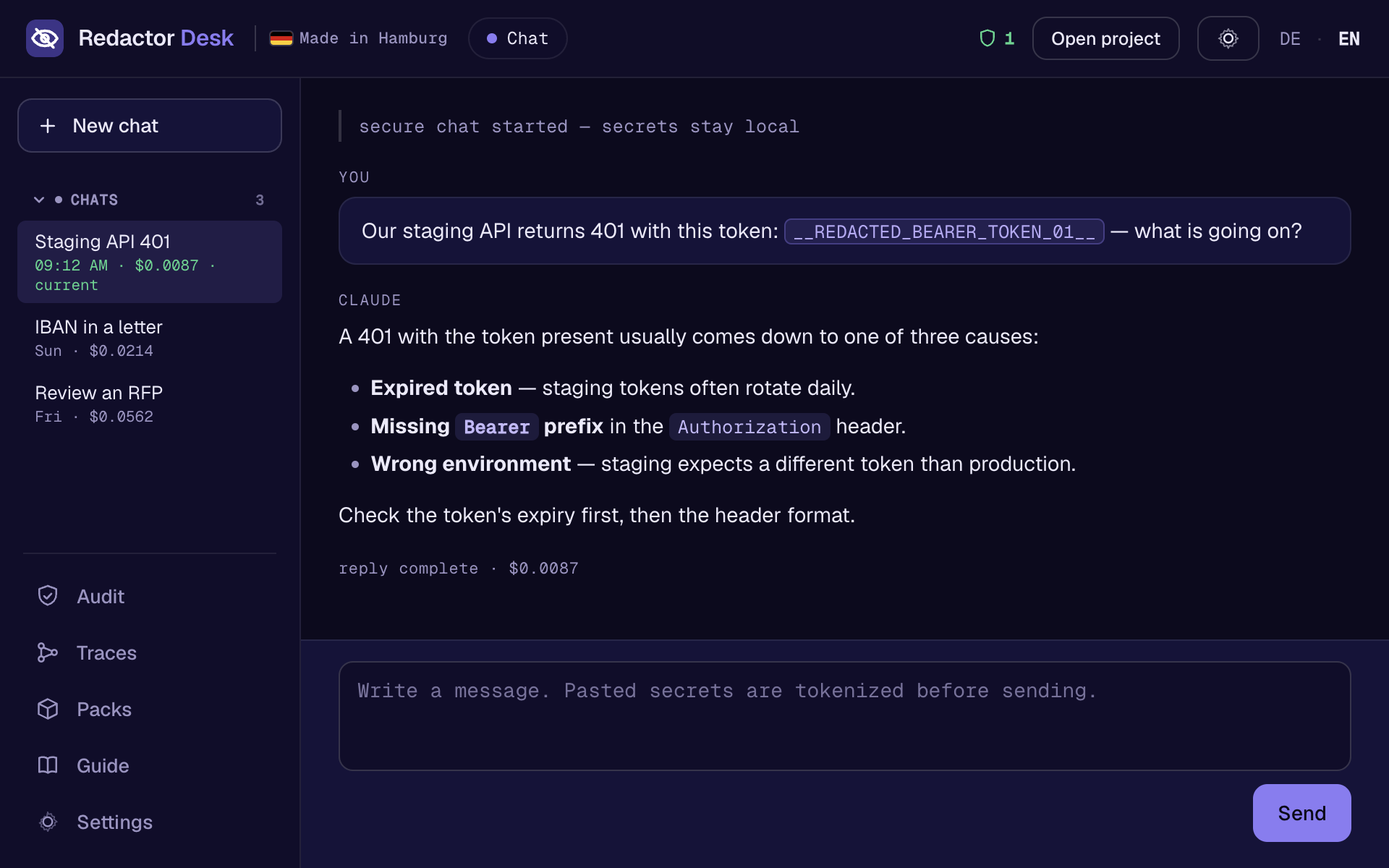
Redactor Desk chat view: a pasted bearer token appears only as a placeholder; the header counts one locally protected value.
Packs

The client stays closed. The packs do not.

Redactor Desk is a proprietary product (closed source) and stays one — so does the redaction engine. What is public is the content of the packs: the prompts, rules and notes themselves. They are licensed under Apache-2.0, as open source in the full sense of the term — readable, copyable and changeable by anyone expected to run them.

  • A pack is text, not a program. It consists of a manifest file and Markdown text, nothing else. It cannot define a tool, read a file, start a process, or touch any permission gate. That is not a house rule — it is a property of the format.
  • The client validates every pack itself. On load it compares the contents against what the manifest declares — including the packs we ship ourselves. Anything that does not line up is not quietly skipped; it is refused in the Packs view, with a reason.
  • Your own packs stay with you. There is no catalogue the client fetches from, and no report of which packs you have enabled. You drop your own pack into a folder — it never leaves your machine.

View the packs on GitHub →

Editions

Personal for individuals. Enterprise for the org.

The redaction engine is identical and full in both editions — protection is never hidden behind a paywall.

Personal

Personal edition

Full redaction · for individuals & consultants

  • Secure chat & project mode with Claude
  • Full local detection & tokenization
  • Your own Anthropic key or Amazon Bedrock (AWS's managed model service) — the key stays encrypted in the keychain
  • German & English, light/dark
  • Automatic updates — signed, straight from us
  • Packs for prompts, rules and notes — shipped with the app or dropped into a folder yourself; the pack contents are licensed under Apache-2.0
  • Prompt enhancing before every send — on the already-sanitized text, and only what you approve goes out
Download for macOS

Free · macOS (Apple Silicon) · signed & notarized · checksums

Enterprise

Enterprise edition

Volume licensing · for regulated organizations

  • Everything in Personal
  • Your own Amazon Bedrock as the model backend — EU inference profile, your own AWS boundary, billed on your AWS invoice
  • No API key on premises: access via your IAM/SSO, temporary credentials, offboarding included
  • Tamper-evident evidence log (hash-chained, hashes only)
  • Managed policy: pin the model, force categories
  • Cloud-side second check (consulting engagement): a scanner reads the Bedrock invocation logs, verifies them independently of the client, and reports findings to AWS Security Hub
  • Offline licensing (Ed25519), volume & support
Who it's for

The tangible way into safe AI use.

For regulated organizations (NIS2, DORA, AI Act) that want to clear agentic coding at all — and for consultants working with sensitive client data. We support your controls; we don't claim to "meet" them.

NIS2DORAEU AI ActGDPRProfessional secrecyData sovereignty

Honest stays honest.

Detection is deterministic and heuristic (regex, checksums, entropy). What isn't detected isn't replaced — which is why regulated organizations pair Redactor Desk with clear policy and training. "Fully offline" applies to detection and tokenization; the client, by nature, talks to the model API — the Anthropic API or your own Amazon Bedrock in the EU region, inside your AWS boundary, with your IAM. More on the security page.

Changes

New in 0.4.1

Current version 0.4.1, released in July 2026. Existing installs pick the update up on their own — signed and notarized, from our own host.

  • Prompt enhancing: a small, fast model sharpens your request before it goes out — you see both versions side by side and decide which one is sent. It runs on the same provider as the rest of your session.
  • Packs: prompts and enhancer rules now arrive as packs — versioned, switchable one by one. Some ship with the app; drop your own into a folder and they appear beside them.
  • German tax and social-security number: both are recognized and tokenized like any other identifier — with their check digits verified, so an invoice number of the same length is left where it is.

See it on your own repository.

We'll show Redactor Desk on your real use case — and support you through adoption in a regulated organization.